

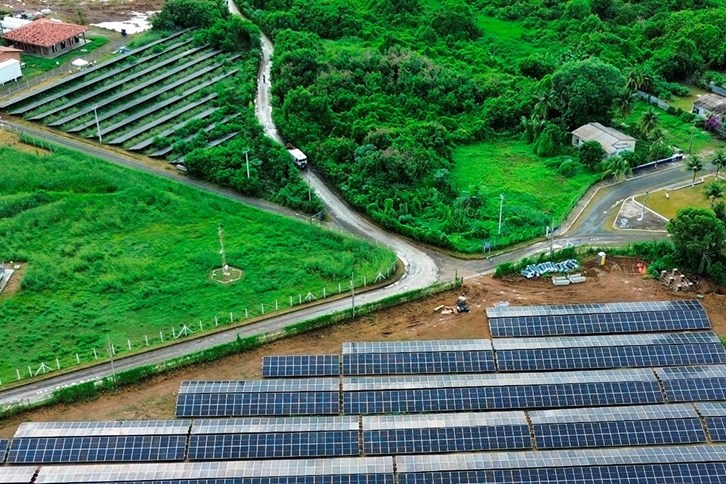
Iberdrola has completed the first phase of the Noronha Verde project in the Fernando de Noronha archipelago (Brazil). The company has already installed 4,800 solar panels – 15% of the total planned – and begun tests to start supplying energy to the island's electricity grid.
This pioneering initiative integrates solar generation and battery storage to turn Fernando de Noronha into the first inhabited oceanic island in Latin America with a highly sustainable energy model, setting a benchmark in self-sufficiency, security and efficiency.
The project, developed by the Group's Brazilian subsidiary, Neoenergia, will feature more than 30,000 solar panels, represents an investment of 350 million reais (more than €50 million) and will be completed by the end of 2026. It is being developed in an environment recognised by Unesco as a Natural Heritage of Humanity.
Noronha Verde will make it possible to eliminate the use of fossil fuels in the island's electricity generation, replacing them with renewable sources and clean technologies. The future solar plant will incorporate advanced battery storage systems and will reach an installed capacity of 22 MWp, with 49 MWh of storage, enough to cover consumption equivalent to that of 9,000 homes. This will help reduce the current dependence on biodiesel generation.
The project, presented last November by Iberdrola's Executive Chairman, Ignacio Galán, and Brazil's Minister for Mines and Energy, Alexandre Silveira, is being developed in partnership with the Federal Government and the Government of the State of Pernambuco. It forms part of the Mais por Noronha programme, which promotes electrification initiatives and new energy solutions on the island, including the installation of solar systems in homes and accommodation, the development of charging infrastructure and distributed microgeneration, the introduction of electric vehicles and the deployment of smart electricity grids.